Availability: In Stock

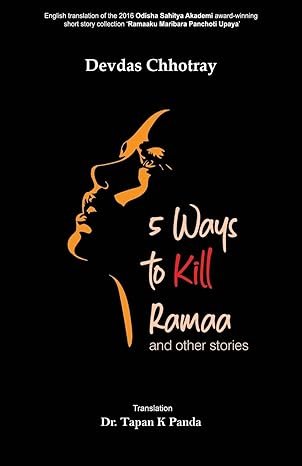
5 Ways to Kill Ramaa and Other Stories

250.00

Fantasy and prudence are like a swing door through which imagination and creativity move without any effort. Devdas Chhotray acknowledges that the stories are tantamount to falsehood though it is perceptible at a certain point.’Five Ways to Kill Ramaa’ is a uniuqe theme of the writer playfully toying with disparate ideas to kill Ramaa. The writer builds a castle in the air and conceptualizes five different ways of doing this. Since her childhood, he has known Ramaa. Then he had frequently visited Tiku, who is Ramaa’s elder brother. She was a sloppy mess and had unkempt hair, which was covered with dandruff, and that’s the reason why her hair was shaved frequently. In his childhood, Ramaa’s living room became a place to enact the play where he and Ramaa acted like a couple and Tiku as a tutor. Ramaa draped herself with Kuni aunty’s saree, decked herself up in jewels and had put vermilion on her forehead. He fantasized about Ramaa in the same attire when he was thirteen. He still remembers when Ramaa wore a saree for the first time. She looked like a beautiful rose in her pink saree. She revealed her grandeur. She appeared like a bride, but he could never see her because, fifteen years after of this incident, she eloped with Bikas and solemnized her marriage in court.Ramaa’s attitude towards the writer was never favourable, but her first saree-draped matured figure transfigured him into a grown-up man.In Bikas and Ramaa’s story, the writer introduces the character, Bikas. Bikas’s personality enticed Ramaa, and she was put under a spell by his charm. Ramaa justified her action and, of course, succeeded in marrying Bikas. The writer was a scapegoat in this affair and witnessed their marriage. His bitterness for Bikas grew with time, and he always tried to find a way to spoil this prospering liaison.’Why to Kill Ramaa’ presents the writer’s devilish vision of slaying Ramaa. In ‘The First Attempt, ‘ the writer spilled kerosene all over the floor and lit a fire. The glass case in which Ramaa was standing was engulfed with fire. The next day he turned the newspaper’s pages, apprehending that the news might have been published but finally concluded that it was his dream but not the reality. In the second, third, fourth, and fifth attempts, the writer lists various strategies to kill Ramaa. These indicate his attitude and resentment for Ramaa.

Categories: ,

Description

Review

Devdas Chhotray’s stories and poems bring the world of adolescence vividly alive and portray its pain and ecstasy with unforgettable acuteness.

Prof. Jatindra Kumar Nayak

About the Author

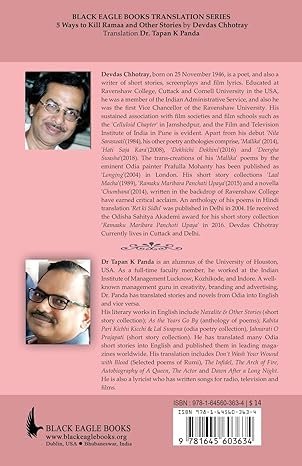
Devdas Chhotray, born on 25 November 1946, is a poet, and also a writer of short stories, screenplays and film lyrics. Educated at Ravenshaw College, Cuttack and Cornell University in the USA, he was a member of the Indian Administrative Service, and also he was the first Vice Chancellor of the Ravenshaw University. His sustained association with film societies and film schools such as the ‘Celluloid Chapter’ in Jamshedpur, and the Film and Television Institute of India in Pune is evident. Apart from his debut ‘Nila Saraswati'(1984), his other poetry anthologies comprise, ‘Mallika’ (2014), ‘Hati Saja Kara'(2008), ‘Dekhichi Dekhini'(2016) and ‘Deergha Swasha'(2018). The trans-creations of his ‘Mallika’ poems by the eminent Odia painter Prafulla Mohanty has been published as ‘Longing'(2004) in London. His short story collections ‘Laal Macha'(1989), ‘Ramaku Maribara Panchati Upaya'(2015) and a novella ‘Chumbana'(2014), written in the backdrop of Ravenshaw College have earned critical acclaim. An anthology of his poems in Hindi translation ‘Ret ki Sidhi’ was published in Delhi in 2004. He received the Odisha Sahitya Akademi award for his short story collection ‘Ramaaku Maribara Panchoti Upaya’ in 2016. Devdas Chhotray Currently lives in Cuttack and Delhi.

Dr. Tapan K Panda is an alumnus of the University of Houston, USA. As a full-time faculty member, he worked at the Indian Institute of Management Lucknow, Kozhikode, and Indore. A well-known management guru in creativity, branding and advertising, Dr. Panda has translated stories and novels from Odia into English and vice versa.His literary works in English include Naxalite & Other Stories (short story collection); As the Years Go By (anthology of poems); Kabita Pari Kichhi Kicchi & Lal Swapna (odia poetry collection), Jahnarati O Prajapati (short story collection). He has translated many Odia short stories into English and published them in leading magazines worldwide. His translation includes Don’t Wash Your Wound with Blood (Selected poems of Rumi), The Infidel, The Arch of Fire, Autobiography of A Queen, The Actor and Dawn After a Long Night. He is also a lyricist who has written songs for radio, television and films.

Product details

  • Publisher ‏ : ‎ Black Eagle Books
  • Publication date ‏ : ‎ 10 February 2023
  • Language ‏ : ‎ English
  • Print length ‏ : ‎ 134 pages
  • ISBN-10 ‏ : ‎ 1645603636
  • ISBN-13 ‏ : ‎ 978-1645603634
  • Item Weight ‏ : ‎ 177 g
  • Dimensions ‏ : ‎ 13.97 x 0.79 x 21.59 cm
  • Country of Origin ‏ : ‎ India
  • Importer ‏ : ‎ Atlantic Publishers and Distributors (P) Ltd., 7/22, Ansari Road, Darya Ganj, New Delhi – 110002 INDIA, Email – customercare@atlanticbooks.com, Ph – 011-47320500
  • Packer ‏ : ‎ Bookswagon, 2/13 Ansari Road, Daryaganj, New Delhi 110002, Sales@bookswagon.com , 01140159253

Indian Edition Also available on:

Additional information

book-author

,

Language

English

select-format

Paperback